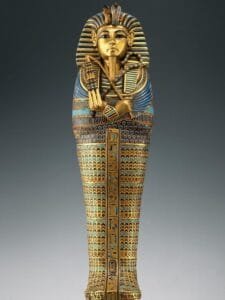
Ornate walking sticks from Tutankhamun’s tomb, including one with a carved Nubian figure. Over 130 canes were found, highlighting their importance in ancient Egyptian life and royalty.
From the muddy lakeshores of prehistory, the humble stick took on new roles as humanity organized into cities and kingdoms. What began as a practical tool for balance and digging became something far more significant: a symbol of authority, healing, and status. By the time of the great ancient civilizations, the walking cane had officially entered high society.
In Ancient Egypt (around 3000–30 BCE), the staff was nothing short of royal. Pharaohs were rarely depicted without one. The most famous combination was the crook and flail — the crook (heka) symbolized gentle guidance of the people, while the flail represented power and punishment. These weren’t just ceremonial; many pharaohs carried beautifully crafted walking sticks for practical support as well.
When Howard Carter opened Tutankhamun’s tomb in 1922, he found more than 130 walking sticks and staves — some plain and well-worn from actual use, others elaborately decorated with gold, silver, and gemstones. One ebony cane even had a handle shaped like a Nubian captive, a powerful statement of dominance. For Egyptian rulers, the cane was both a mobility aid and a visible reminder that they “held up” the world.

The Rod of Asclepius — a single serpent coiled around a staff — became the enduring symbol of medicine and healing from ancient Greece onward.”
The Greeks added layers of mythology and medicine. The god Hermes carried the caduceus (a staff with two intertwined snakes), symbolizing commerce and negotiation. But the more enduring symbol was the staff of Asclepius — a single serpent coiled around a wooden rod — which became the universal emblem of medicine and healing that we still use today.
For ordinary citizens, especially the elderly or injured, a simple wooden staff remained essential. Greek literature often mentions elders leaning on sticks while offering wisdom in the agora. Aristotle himself reportedly used one in his later years. The cane had become a mark of thoughtful maturity rather than just frailty.
The Romans took the idea and made it even more official. High-ranking officials and senators carried ornate canes as badges of office. Victorious generals sometimes received elaborate staffs during triumphs. Roman doctors recommended walking sticks for the elderly and those recovering from injury, showing an early understanding of their medical value. The fasces — a bundle of rods with an axe — symbolized magisterial power and the right to punish.
Across these cultures, the cane also carried spiritual weight. Pilgrims, priests, and travelers used sturdy staffs for long journeys, turning them into symbols of faith and endurance. A good staff could mean the difference between reaching a distant temple or collapsing along the way.
By the end of the ancient world, the walking cane had completed its first great evolution. No longer just a survival tool, it had become an extension of identity — a visible sign of power, wisdom, healing, and status.
Yet its story was far from over. In the turbulent centuries that followed the fall of Rome, the cane would take on new roles as both weapon and companion through war, faith, and feudal life. That’s where we’ll pick up next…
Walking Canes Through History – Series Navigation
- Part 1: The Original Stick: When Humanity’s First Tool Was Also Its First Walking Aid ← You are here
- Part 2: Staffs of Power: Canes in Ancient Civilizations
- Part 3: Coming Soon…
- Part 4: Coming Soon…
- Part 5: Coming Soon…

0 Comments