The Original Stick: When Humanity’s First Tool Was Also Its First Walking Aid
Picture this: It’s roughly 430,000 years ago, long before anyone dreamed of wheels, writing, or even reliable fire-starting. A group of early humans—maybe Homo heidelbergensis, our distant ancestors—huddles by a lakeshore in what is now Greece. One of them picks up a sturdy alder branch, strips away the twigs with a sharp stone, and smooths a handle. What emerges isn’t just a random piece of wood. It’s a digging stick—one of the oldest handheld wooden tools ever discovered. An ancient Elon might have called this “Off the tree technology”.
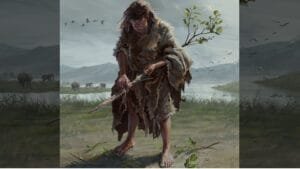
Archaeologists recently unearthed this 81-centimeter marvel (along with a second, smaller wooden implement) at the Marathousa 1 site in Greece. Use-wear analysis indicates it was deliberately shaped for digging roots and tubers, or perhaps for prying open shellfish. But here’s the thing: that same stick could steady someone climbing a slippery bank, probe the ground ahead in tall grass, or deliver a swift whack to a predator. It was a tool, a weapon, and a walking aid all in one—humanity’s original Swiss Army knife.
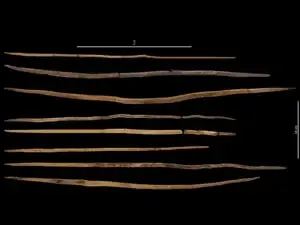
Fast-forward a bit (to about 300,000 years ago), and we meet the rock stars of prehistoric woodworking: the Schöningen spears from Germany. Ten beautifully crafted wooden spears—some nearly 2.5 meters long—were found alongside butchered horse bones. These weren’t crude clubs; they were precision-engineered thrusting and throwing weapons, shaved, seasoned, and sanded with remarkable skill. Nearby, lighter “throwing sticks” (think early boomerang-style projectiles) were perfect for smaller game, such as rabbits or birds. Early humans weren’t just picking up random branches—they were master woodworkers.
Sticks weren’t a luxury; they were survival gear. Uneven terrain, injuries from hunts, or simply the aches of an active life would have made a sturdy branch invaluable for balance. Even today, we see echoes of this in primates: gorillas in the wild have been observed using sticks as walking aids on tricky ground. Our ancestors almost certainly did the same. A good stick lets you test the depth of a stream, knock fruit from a high branch, fend off a rival, or lean on when your knees protest after a long trek.
Wood rots quickly, so direct evidence is rare. But the few surviving pieces paint a clear picture: long before stone axes or bows, the humble stick was humanity’s first technology. It helped us hunt smarter, gather more efficiently, and—yes—walk farther and safer.

A primitive hunter crouches carefully with a spear in a lush forest.
And here’s the beautiful part: that same stick would eventually become something far grander. As humans formed societies, the simple walking aid transformed into a symbol of power, a fashion statement, and a hidden weapon. But that’s a story for next time…
Walking Canes Through History – Series Navigation
- Part 1: The Original Stick: When Humanity’s First Tool Was Also Its First Walking Aid ← You are here
- Part 2: Staffs of Power: Canes in Ancient Civilizations
- Part 3: Coming Soon…
- Part 4: Coming Soon…
- Part 5: Coming Soon…
[NEXT → Button] Read Next: Staffs of Power: Canes in Ancient Civilizations
0 Comments